

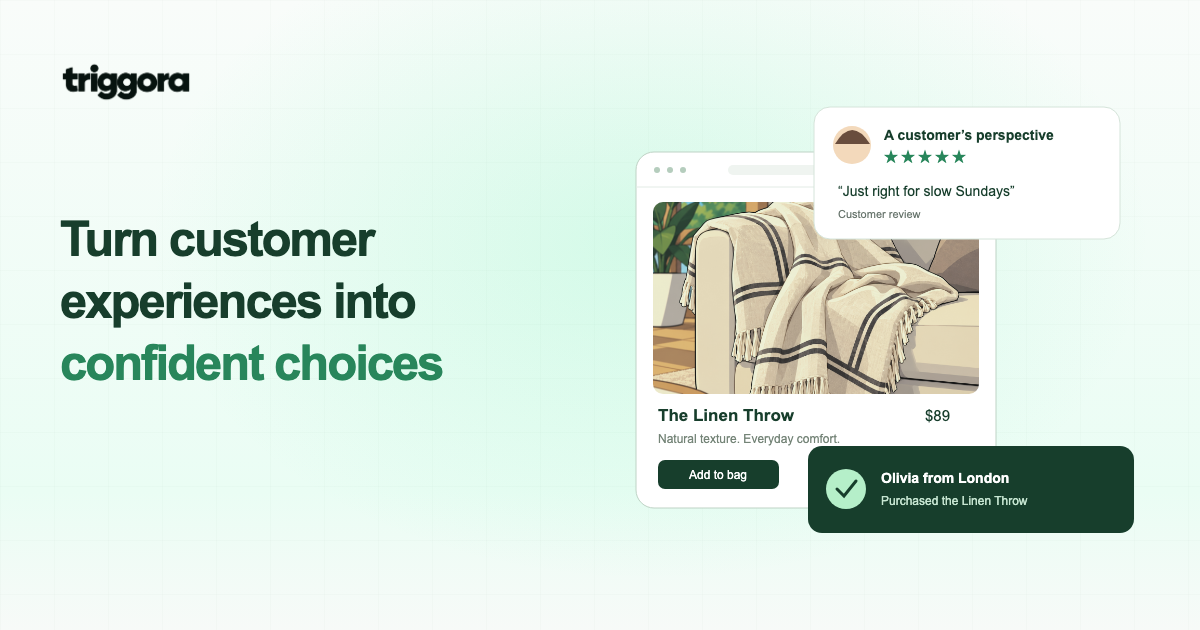
Your product photos look great. Your description answers the obvious questions. But a first-time visitor still has one you cannot answer with another sales claim: “Can I trust this?” Social proof helps close that gap by showing what other customers actually experienced.
- Use customer evidence to answer a specific buying question, rather than decorating every page with notifications.
- Put detailed reviews and customer photos near the product decision; keep purchase activity relevant and unobtrusive.
- Show genuine activity, explain verification labels, and measure the effect on purchases alongside user experience.
Why social proof matters when shoppers cannot try the product
Ecommerce asks customers to make a decision before they can touch, test, or try an item. An unfamiliar brand adds another layer of uncertainty: will the product match the photos, and will the business deliver what it promises?
It helps shoppers assess risk
A useful review turns a vague worry into a concrete answer. A photo from someone with a similar room, skin tone, or use case can help a visitor judge whether a product fits their needs. Relevant evidence matters more than a large pile of generic praise.
It makes your claims easier to evaluate
Specific accounts of customer experience can support your product description. They can also reveal limitations. If a travel bag fits a weekend’s clothes but not a large laptop, that information helps the right person buy and helps another person avoid a disappointing purchase.
The Medill Spiegel Research Center’s research on online reviews links review availability and characteristics to purchase likelihood in the datasets studied. Its findings also show that effects depend on factors such as product price, rating, and review source. Treat this as evidence that reviews can matter, not a universal forecast for your store.
Put the evidence where the doubt happens
Placement should follow the question a shopper is trying to answer. Start with your most important product pages rather than adding every available widget across the whole store.
| Location | Shopper’s question | Useful evidence |
|---|---|---|
| Homepage | Is this brand relevant to me? | A specific customer story or permissioned customer photo |
| Product page | Will this work for my needs? | Reviews, fit details, photos, and questions about that product |
| Collection page | Which option should I explore? | Accurate ratings and review counts beside each item |
| Cart | Am I ready to commit? | Relevant reassurance that leaves the total and checkout controls visible |
On mobile, a notification can occupy a large share of the screen. Keep it small, allow dismissal when appropriate, and make sure it does not cover the add-to-cart button, product options, consent controls, or checkout navigation. Test with the actual page layout, not just an isolated widget mockup.
Protect the credibility of your social proof
The quickest way to weaken a trust signal is to make it look more certain than the underlying evidence allows. A live visitor count should come from a defined, current measurement. A recent purchase message should not imply that an old or synthetic event happened moments ago. A verification badge should explain what was checked.
Do not fabricate customer reviews or tie review incentives to a positive rating. The FTC’s guidance on its Consumer Reviews and Testimonials Rule addresses fake reviews and sentiment-conditioned incentives. It also explains that undisclosed incentives can raise separate concerns. Check the requirements that apply to your market.
Avoid suppressing legitimate criticism just to create a perfect-looking rating. A useful response to a problem can tell shoppers more about your business than another unqualified compliment. And if you have few customers, start there honestly: invite real feedback rather than filling the gap with made-up activity.
Measure whether it helps customers buy
A widget getting clicks does not necessarily mean it improves the shopping experience. Choose one primary outcome, such as completed purchases per eligible visitor, before making a change. Then watch for side effects.
- Establish a baseline. Record current conversion, traffic sources, device mix, and any promotions that could affect the result.
- Test one meaningful change. For example, add product-specific reviews or a restrained recent-sales notification. Randomize comparable visitors if your experimentation setup supports it.
- Check the whole journey. Look at completed purchases alongside revenue per visitor, checkout abandonment, loading performance, and mobile usability.
- Allow enough evidence. Choose the sample size and duration around your traffic and expected effect. Do not stop a test just because a small early result looks encouraging.
Segmenting by device or product category can help explain a result, but avoid treating every small subgroup difference as a discovery. If the change has no clear benefit, simplify it, move it, or remove it.
A practical starting point for your store
Choose one product with healthy traffic and a genuine source of customer evidence. List the main hesitation shoppers have about that product, then select the signal that answers it most directly.
- If shoppers ask about sizing, improve fit-focused reviews and customer photos.
- If the brand is unfamiliar, use a detailed customer story and clear service information.
- If you have real order activity to share, try a relevant purchase notification with careful timing and minimal customer details.
Triggora helps you place trust widgets on your website and preview how they fit your layout. You can try a visual preview on your own website or explore the widget library. Preview notifications use sample data; a live store should connect genuine events and follow its privacy requirements.
The goal is a better-informed visitor. When your evidence is specific, authentic, and placed thoughtfully, social proof becomes a useful part of the buying decision rather than another interruption.
Sources & further reading
- Medill Spiegel Research Center: How Online Reviews Influence Sales
- Federal Trade Commission: Consumer Reviews and Testimonials Rule — Questions and Answers
Published . This article is educational; results depend on your store and implementation.